Friday, 4 June 2021

Steps to Internationalize your Service Business (Service Marketing 04.06.2021)

Steps to Internationalize your Service Business

Internationalizing a service business is a significant undertaking, but when you approach it methodically and thoughtfully, it can transform your company and lead to incredible opportunities. Let’s take a look at the steps toward internationalizing a business.


1. Choose Your Expansion Country

Using reliable and accurate metrics, evaluate the market attractiveness of each country under consideration. Look for the best fit for your particular products and services, noting the following factors:

·                  Demand for your products and services

·                  Local regulations that would affect your business

·                  Taxation issues

·                  Licensing and certification


2. Conduct a Market Analysis

Tools like Porter’s Five Forces and the classic SWOT analysis can be beneficial in determining the advantages and disadvantages of setting up a business in specific countries. As you analyze your options, pay special attention to the external environment, since this will be the most substantial departure from your current operations.


3. Plan Your Market Entry

Will your current business model work well in the new country? To successfully enter the new market, you may want to consider acquiring a local business to capture their core business expertise. In this way, you can access local knowledge or make a strategic alliance with an existing company.


4. Evaluate Your Market Position

You know and understand your position in the current local market, but you’ll need to consider your positioning in international markets. Evaluate the competition and their positioning to help you find your own place. Some businesses find that they must seek out a new niche or modify their products to fit well in their new market.


5. Consider Your Targets

Due to differences in consumer taste, lifestyle, and spending, you may need to target different customers internationally than you do at home. Carefully analyze geographical, demographic, psychographic, and behavioral data as you narrow in on your target customer base.


6. Fine-tune your Services

Do your current products and services meet the needs of consumers in your target countries? Many businesses find that they need to adapt their products / services to suit the needs and desires of their international customers.


Market research will help you to determine demand in your target countries. If you can meet specific needs and wants of local consumers, your chances of success will increase substantially.


7. Evaluate Core Competencies

Once you’ve gathered about your market position, target customers, and products and services, it’s time to evaluate your core competencies.


Do you currently have access to the skills and resources you need to position your business internationally successfully? If not, do you know how to acquire those core competencies? Will you be able to hire locally for critical positions? Alternatively, will you need to relocate workers for specific jobs?


8. Analyze Supply Chain and Value Chain Options

Internationalizing a business requires attention to importing / exporting, franchising, regulations, and licensing. Do you have systems in place to manage all elements of your supply chain? How will you acquire everything you need in your new location? Moreover, how do the costs stack up with your current cash flow and budgetary requirements?


Consulting with an international business expert can help you to determine whether now is an advantageous time for your company to internationalize. Team up with an adviser who knows the ins and outs of the process.

Strategy Formulation (Retail Strategy 04.06.2021)

Chapter 7

Retail Strategy Formulation in according to Resource analysis and Application


Strategy Formulation

Definition: Strategy Formulation is an analytical process of selection of the best suitable course of action to meet the organizational objectives and vision.


It is one of the steps of the strategic management process. The strategic plan allows an organization to examine its resources, provides a financial plan and establishes the most appropriate action plan for increasing profits.


It is examined through SWOT analysis. SWOT is an acronym for strength, weakness, opportunity and threat. The strategic plan should be informed to all the employees so that they know the company’s objectives, mission and vision. It provides direction and focus to the employees.


Steps of Strategy Formulation

The steps of strategy formulation include the following:


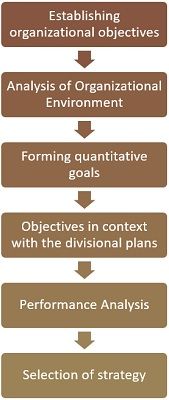
1. Establishing Organizational Objectives: This involves establishing long-term goals of an organization. Strategic decisions can be taken once the organizational objectives are determined.


2. Analysis of Organizational Environment: This involves SWOT analysis, meaning identifying the company’s strengths and weaknesses and keeping vigilance over competitors’ actions to understand opportunities and threats.


Strengths and weaknesses are internal factors which the company has control over. Opportunities and threats, on the other hand, are external factors over which the company has no control. A successful organization builds on its strengths, overcomes its weakness, identifies new opportunities and protects against external threats.


3. Forming quantitative goals: Defining targets so as to meet the company’s short-term and long-term objectives. Example, 30% increase in revenue this year of a company.


4. Objectives in context with divisional plans: This involves setting up targets for every department so that they work in coherence with the organization as a whole.


5. Performance Analysis: This is done to estimate the degree of variation between the actual and the standard performance of an organization.


6. Selection of Strategy: This is the final step of strategy formulation. It involves evaluation of the alternatives and selection of the best strategy amongst them to be the strategy of the organization.


Strategy formulation process is an integral part of strategic management, as it helps in framing effective strategies for the organization, to survive and grow in the dynamic business environment.


Levels of strategy formulation

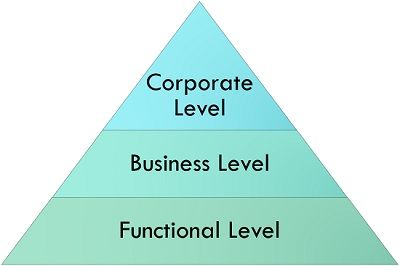
There are three levels of strategy formulation used in an organization:


1. Corporate level strategy: This level outlines what you want to achieve: growth, stability, acquisition or retrenchment. It focuses on what business you are going to enter the market.


2. Business level strategy: This level answers the question of how you are going to compete. It plays a role in those organization which have smaller units of business and each is considered as the strategic business unit (SBU).


3. Functional level strategy: This level concentrates on how an organization is going to grow. It defines daily actions including allocation of resources to deliver corporate and business level strategies.


Hence, all organisations have competitors, and it is the strategy that enables one business to become more successful and established than the other.


System Analysis and Design (MIS 04.06.2021)

System Analysis and Design


Systems Analysis and Design is an active field in which analysts repetitively learn new approaches and different techniques for building the system more effectively and efficiently. The primary objective of systems analysis and design is to improve organizational systems.


Systems development is systematic process which includes phases such as:

(1) planning,

(2) analysis,

(3) design,

(4) deployment, and

(5) maintenance.


We will primarily focus on –


1. Systems analysis

2. Systems design


1. Systems Analysis

It is a process of collecting and interpreting facts, identifying the problems, and decomposition of a system into its components.


System analysis is conducted for the purpose of studying a system or its parts in order to identify its objectives. It is a problem-solving technique that improves the system and ensures that all the components of the system work efficiently to accomplish their purpose.


Analysis specifies what the system should do.


2. Systems Design

It is a process of planning a new business system or replacing an existing system by defining its components or modules to satisfy the specific requirements. Before planning, you need to understand the old system thoroughly and determine how computers can best be used in order to operate efficiently.


System Design focuses on how to accomplish the objective of the system.


Thursday, 3 June 2021

Factors to Consider Before Going International (Service Marketing 03.06.2021)

Factors to Consider Before Going International

Factor 1: Get company-wide commitment. Every employee should be a vital member of your international team, from the executive suite to customer service through engineering, purchasing, production and shipping. You're all in it for the long term.


Factor 2: Define your business plan for accessing international markets. An international business plan is important in order to define your company's present status and internal goals and commitment, but it's also necessary if you plan to measure your results.


Factor 3: Determine how much you can afford to invest in your international expansion efforts. Will it be based on ten percent of your domestic business profits or on a pay-as-you-can-afford process?


Factor 4: Plan at least a two-year lead-time for international market penetration. It takes time and patience to build a great, enduring international enterprise, so be patient and plan for the long term.


Factor 5: Build a website and implement your international plan sensibly. Many companies offer affordable packages for building a website, but you must decide in what language you'll communicate. English is unarguably the most important language in the world, but only 28 percent of the European population can read it. That percentage is even lower in South America and Asia. Over time, it would be best to slowly build a site that communicates sensibly and effectively with the world.


Factor 6: Pick a product or service to take overseas. You can't be all things to all people. Decide on something. Then stick with it.


Factor 7: Conduct market research to identify your prime target markets. You want to find out where in the world your product / service will be in greatest demand. Market research is a powerful tool for exploring and identifying the fastest-growing, most penetrable market for your product / service.


Factor 8: Search out the data you need to predict how your product / service will sell in a specific geographic location.  Doing your homework will enable you to find out how much you'll be able to sell over a specific period of time.


Factor 9: Prepare your product / service for export. You should expect to adapt your product / service to some degree for sale outside your domestic markets before you make your first sale. Packaging (deal) plays a vital role in enabling international connections. Make yours the best in its class, and you'll be able to sell it anywhere in the world.


Factor 10: Find cross-border customers. There is no business overseas for you unless you can locate customers first.


Factor 11: Establish a direct or indirect method of export. It all boils down to export strategy and how much control you wish to exercise over your ventures. On the other hand, readiness to seize an opportunity is more important than having your whole strategy nailed down beforehand.


Factor 12: Hire a good lawyer, a savvy banker, a knowledgeable accountant and a seasoned transport specialist, each of whom specializes in international transactions. You may feel you can't afford these professional services, but you really can't afford to do without them.


Factor 13: Prepare pricing and determine your landed costs. Be ready to test out your price on your customer. See what reaction you get and then negotiate from there.


Factor 14: Set up terms, conditions and other financing options. Agree on terms of payment in advance, and never, ever sell on open account to a brand-new customer. No ifs, ands or buts. Just don't.


Factor 15: Brush up on your documentation and export licensing procedures. If you find it too time consuming, hire a freight forwarder who can fill you in on the spot. Ask a lot of questions. Use their expertise to your advantage.


Factor 16: Implement an extraordinary after-sales service plan. The relationship between your company and your overseas customer shouldn't end when a sale is made. If anything, it should be just the start of a long relationship which requires more of your attention. The "care and feeding" of your customers will determine if they keep coming back for more.


Factor 17: Make personal contact with your new targets, armed with culture-specific information and courtesies, professionalism and consistency. Your goal should be to enter a different culture, adapt to it and make it your own.


Factor 18: Investigate international business travel tips. The practical aspects of international business can make or break the success of your trip. In preparing to go boldly where you've never gone before, plan accordingly.


Factor 19: Explore cross-border alliances and partnerships. In charting your international strategy, consider joining forces with another company of similar size and market presence that's located in a foreign country where you're already doing business, or would like to.

Gauge your readiness-or willingness-to take on a 50/50 partnership and what it can and cannot do for you.


Factor 20: Enjoy the journey. Never forget that you are the most important and valuable business asset you have, and that the human touch is even more precious in our age of advanced technology. Take the best possible care of yourself, your employees, your suppliers and your customers, and your future will be bright, prosperous and happy.


When, How, Steps to conduct a SWOT analysis and Achievement (Retail Strategy 03.06.2021)

Chapter 6

Internal Retail Strategy Analysis


When to conduct a SWOT analysis

A SWOT analysis can be used in a variety of situations — it’s not restricted by a specific industry or department.


SWOT can be used to explore new ventures, products, acquisitions or mergers. It can help businesses change course mid-project, plan out how to invest money, understand competitors and to identify the brand’s mission.


SWOT can also help non-profit companies and government agencies manage or allocate grants, donations and funding. It’s a flexible analysis tool that can be applied to a range of business situations relating to everything from IT to marketing to operations.


How to conduct a SWOT analysis

The process can be as simple or complex as you make it. It’s something that can be done during workshops, meetings, brainstorming sessions or when evaluating products or competition.


A SWOT analysis begins with listing out the objectives, business venture or project and identify any internal or external factors that will help or hurt the path to achieving those objectives.


Objectives can include anything from small or major business decisions to new or improved products and services. If an objective is deemed attainable, the process starts over with a different objective.


Main steps for performing a SWOT analysis are:

1. Collect relevant information and list all current known strengths and weaknesses. This can be achieved through talking to others in the organization or through larger brainstorming sessions. You should come prepared with questions pertaining to the SWOT objective and aim to get thoughtful and insightful responses from your team.


2. Consider all the potential opportunities that exist for the organization, including future trends and technologies.


3. Review the SWOT matrix to build a plan that addresses each area including everything that’s working and everything that needs to change.


What will SWOT analysis achieve?

A SWOT analysis is essentially a way to get the organization focused on specific goals, projects and objectives. It’s an organized approach that helps businesses identify ways to improve efficiency and productivity.


A SWOT analysis will answer the following questions:

1. What are the internal strengths and weaknesses of your company?

2. What are the external opportunities and threats in your industry and its environment?

3. Can any weaknesses be converted to strengths? Any threats into opportunities?

4. How can your company take advantage of strengths and opportunities?

5. What strategic changes can your company implement as a result of the SWOT analysis?


SWOT analysis examples

SWOT analyses from major corporations can help you get an idea of how the process works. Strategic Management Insight offers examples of SWOT analyses for a wide range of companies, including Google, Starbucks and Amazon.


Its example SWOT analysis of Microsoft evaluates the potential impact of a major leadership change in the organization — in this case, the hiring of CEO Satya Nadella.


Analysts Insight identifies Microsoft’s strengths as the company’s brand awareness, it’s wide acceptance in the enterprise, easy-to-use products, a worldwide network of distributors and an ability to beat analyst’s expectations. Weaknesses include being late to mobile computing, a lack of urgency when the internet was introduced and security flaws in its software.

Cloud computing was seen as a big opportunity for Microsoft at that time, as the organization had the chance to take the lead in this trend, and the company was economically strong. Microsoft’s biggest threats included the company’s size, which can slow progress, as well as a failure to notice emerging trends, piracy and lawsuits.


The SWOT analysis concludes that Microsoft needs to keep an eye on market trends to avoid misreading major technological shifts. The organization should also focus more heavily on the enterprise to set itself apart from other tech companies that are only focused on the consumer base.


Components & Types of a Decision Support System, Advantages & Disadvantages (MIS 03.06.2021)

Components of a Decision Support System

The three main components of a DSS framework are:

 1. Model Management System

The models are used in decision-making regarding the financial health of the organization and forecasting demand for a good or service.


2. User Interface

The user interface includes tools that help the end-user of a DSS to navigate through the system.


3. Knowledge Base

The knowledge base includes information from internal sources (information collected in a transaction process system) and external sources (newspapers and online databases).


Types of Decision Support Systems

1. Communication-driven: Allows companies to support tasks that require more than one person to work on the task. It includes integrated tools such as Microsoft SharePoint Workspace and Google Docs.


2. Model-driven: Allows access to and the management of financial, organizational, and statistical models. Data is collected, and parameters are determined using the information provided by users. The information is created into a decision-making model to analyse situations.


3. Knowledge-driven: Provides factual and specialized solutions to situations by using stored facts, procedures, rules, or interactive decision-making structures like flowcharts.


4. Document-driven: Manages unstructured information in different electronic formats.


5. Data-driven: Helps companies to store and analyse internal and external data.


Advantages of a Decision Support System

1. A decision support system increases the speed and efficiency of decision-making activities. It is possible, as a DSS can collect and analyse real-time data.


2. It promotes training within the organization, as specific skills must be developed to implement and run a DSS within an organization.


3. It automates monotonous managerial processes, which means more of the manager’s time can be spent on decision-making


4. It improves interpersonal communication within the organization.


Disadvantages of a Decision Support System

1. The cost to develop and implement a DSS is a huge capital investment, which makes it less accessible to smaller organizations.


2. A company can develop a dependence on a DSS, as it is integrated into daily decision-making processes to improve efficiency and speed. However, managers tend to rely on the system too much, which takes away the subjectivity aspect of decision-making.


3. A DSS may lead to information overload because an information system tends to consider all aspects of a problem. It creates a dilemma for end-users, as they are left with multiple choices.


4. Implementation of a DSS can cause fear and backlash from lower-level employees. It is because many of them are not comfortable with new technology and are afraid of losing their jobs to technology.